What is Damascus steel — and what makes a blade authentic
6 min read · Updated 2026-08-29
Damascus is not a coating, a finish, or a brand name. It is pattern-welded steel: two or more alloys forge welded into one bar, then drawn, folded and manipulated until the layers themselves draw the pattern you see on the flat of the blade.
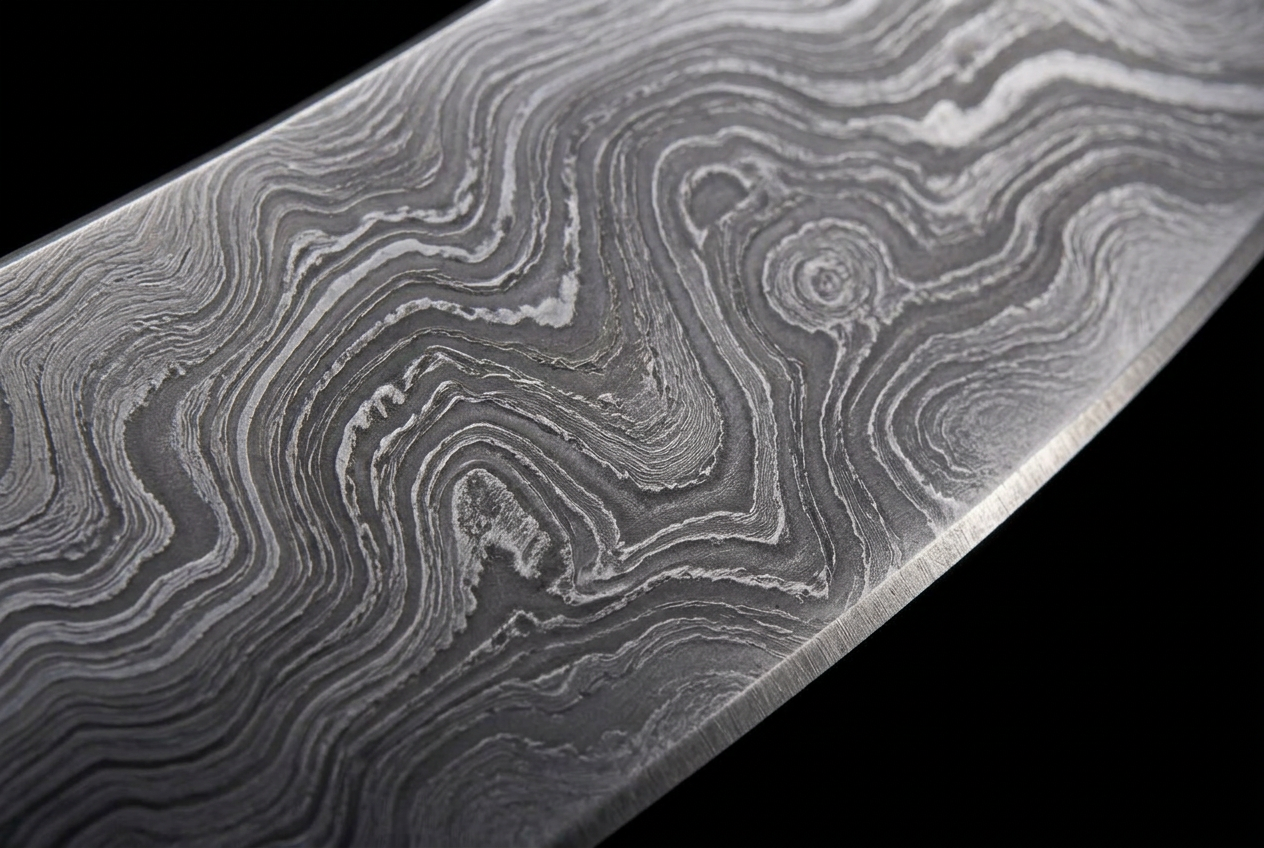
How a Damascus billet is actually built
- 01Alternating layers of a hard, high-carbon steel and a tougher, lower-carbon steel are cleaned and stacked into a billet.
- 02The stack is brought to welding heat and set with a hammer or press until the layers fuse into a single bar.
- 03The bar is drawn out, cut, folded and welded again. Each cycle doubles the layer count.
- 04Ladder, raindrop and twist patterns are cut, drilled or twisted into the bar — the pattern is physically moved, not printed.
- 05The blade is forged to profile, normalized, hardened, tempered, then etched in acid so the two alloys read at different depths.
Layer count is not a quality score
A clean 120-layer billet with a correct heat treat outperforms a dirty 500-layer billet every time. Cutting performance comes from the steel recipe and heat treat; layers control how the pattern reads.
Real pattern-welded vs. laser-etched fakes
| Tell | Authentic pattern weld | Etched or printed fake |
|---|---|---|
| Spine and tang | Pattern continues through the spine and into the tang | Pattern stops at the polished face |
| Sharpening | Pattern stays after you regrind the edge | Pattern vanishes at the bevel |
| Feel | Faint topography you can feel with a fingernail | Perfectly flat under the finger |
| Repeats | Organic, never a perfect repeat | Identical repeating tile across blades |
| Price | Reflects hours of forge work | Suspiciously cheap for the look |
Common Damascus core steels and what they do
| Steel | Where you see it | Character |
|---|---|---|
| VG-10 core, stainless cladding | Japanese chef knives, gyuto and santoku | Keen edge, easy upkeep, very forgiving |
| AUS-10 | Kitchen Damascus at working prices | Tough, stain resistant, quick to sharpen |
| Aogami / blue paper carbon | Traditional Japanese kitchen blades | Screaming sharp, reactive, patinas fast |
| 1084 / 15N20 mix | Western hand-forged Damascus | Classic high-contrast pattern, carbon care |
| S35VN, Magnacut | EDC folders and hard-use fixed blades | Long edge life, corrosion resistance |
Is Damascus a good knife steel?
Judge the core steel and the heat treat, not the word Damascus. A pattern-welded blade with a proven core and a documented hardness is an excellent knife. A pattern-welded blade with an unnamed steel and no hardness spec is jewellery. Ask for the steel, the Rockwell hardness and who ground it — any honest seller can answer all three.
Straight answers
- Is Damascus steel stronger than regular steel?
- Not inherently. Modern pattern welding is done for the pattern; strength and edge retention come from the core steel choice and heat treat.
- Does Damascus rust?
- Carbon Damascus will patina and can rust if stored wet. Stainless-clad Damascus with a VG-10 or AUS-10 core is far more forgiving.
- How much should a real Damascus knife cost?
- Honest hand-forged kitchen Damascus generally starts near $120 and climbs with layer work, handle materials and maker reputation. Sub-$40 mirror-pattern knives are almost always etched.
Next step
Put it to work on a real blade
Every knife on our rack lists its steel and origin, so you can apply everything above before you buy.