Nine sharpening mistakes that ruin good knives
7 min read · Updated 2026-09-02
Most knives that arrive at our bench 'dull' are not worn out. They have been sharpened badly: rounded shoulders, a rolled apex, a burr never removed, or a bevel that never actually reached the edge. Every one of these is fixable, and avoidable.
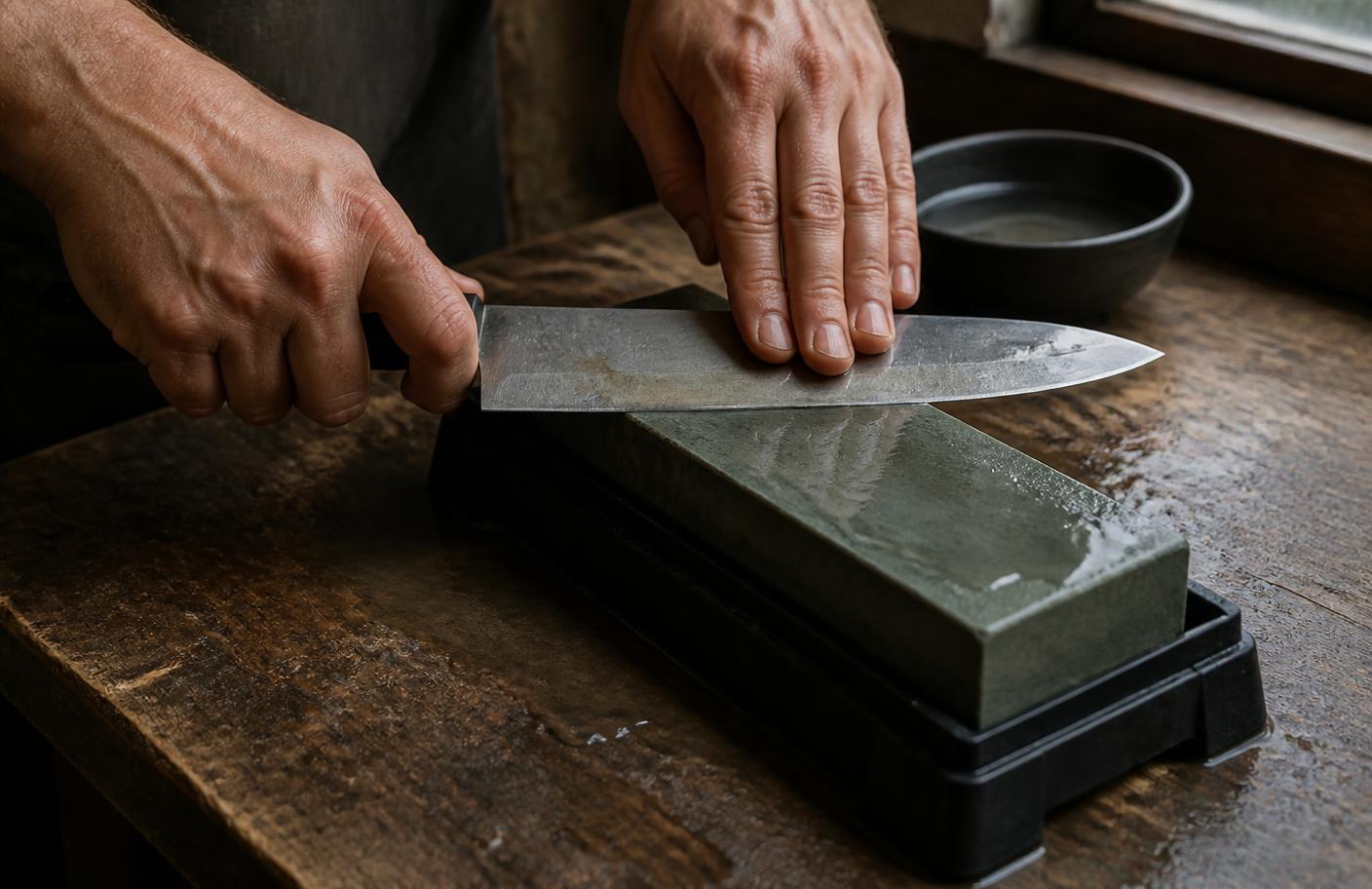
The nine we see most
| Mistake | What it does | Fix |
|---|---|---|
| Never reaching the apex | Feels sharp on the bevel, still dull at the edge | Sharpen until you raise a burr along the full length |
| Inconsistent angle | Convex, rounded shoulders that will not bite | Fix your elbow, move from the shoulder, use an angle guide |
| Too steep an angle | A durable edge that cuts poorly | 15° per side for Japanese kitchen, 20° for hard-use |
| Skipping the deburr | Sharp for one cut, then instantly dull | Alternate light edge-trailing passes, then strop |
| Too much pressure | Rolled apex, deep scratches, dished stone | Finish at the weight of the knife alone |
| Dry or unflattened stone | Glazed stone, uneven bevel | Soak or splash as specified, flatten before every session |
| Pull-through sharpeners | Tears carbides out of hard steel | Stones, or a guided system |
| Grinding on a bench grinder | Overheats and ruins the heat treat | Hand stones, or a slow water-cooled wheel |
| Sharpening too rarely | Long, aggressive re-profiling sessions | A few strokes monthly instead of a rescue once a year |
How to know you reached the edge
- 01Mark the bevel with a permanent marker before you start.
- 02Take five light passes, then look: marker should be gone all the way to the apex, not just at the shoulder.
- 03Feel for the burr — run a fingertip perpendicular off the edge, never along it. A burr feels like a faint wire.
- 04Work the same burr down the whole length before you flip the knife.
- 05Alternate progressively lighter passes to remove the burr, then test on paper.
Heat is the one unrecoverable error
Anything above roughly 200°C (a straw-coloured tint on the steel) permanently softens the edge. If a bevel changes colour on a powered wheel, that steel has to be ground away before the knife will hold an edge again.
The three-test check
- Paper: it should slice cleanly through printer paper with no snagging along the whole edge.
- Thumbnail: gently rest the edge on a nail. It should catch, not slide.
- Tomato: the tip should start the cut on its own weight, without sawing.
A grit plan that covers most knives
| Stage | Grit | When |
|---|---|---|
| Repair | 220–400 | Chips, reprofiling, badly rounded edges only |
| Sharpen | 1000 | The actual work — where the new apex is set |
| Refine | 3000–5000 | Kitchen knives, push cutting, clean tomato skins |
| Polish/strop | 6000+ or leather | Deburring and maintenance between sharpenings |
Straight answers
- Why is my knife still dull after sharpening?
- Almost always because you never raised a burr along the whole edge, or you left the burr on. Marker-test the bevel and confirm the burr before moving to a finer grit.
- Are pull-through sharpeners bad?
- For soft Western stainless they are survivable. On a 60+ HRC Japanese or Damascus blade they rip material out of the apex and leave a weak, ragged edge.
- How often should I sharpen a kitchen knife?
- A light touch-up every four to six weeks with normal home use. Frequent small sessions are faster, safer for the blade, and less work than an annual rescue.
- Can honing rods replace sharpening?
- A rod realigns a rolled edge; it removes almost no steel. Use a fine ceramic rod between sessions and stones when the edge stops responding to it.
Next step
Test your new edge on steel worth sharpening
Our blades list steel and hardness so you can pick the right stones and angle from day one, and every knife we sell qualifies for lifetime resharpening through the club.