Which knife claims actually matter — and which are marketing
6 min read · Updated 2026-09-02
Knife listings are full of numbers that sound technical and mean nothing. Here is what we would check if we were the buyer, in the order that actually predicts how a knife performs.
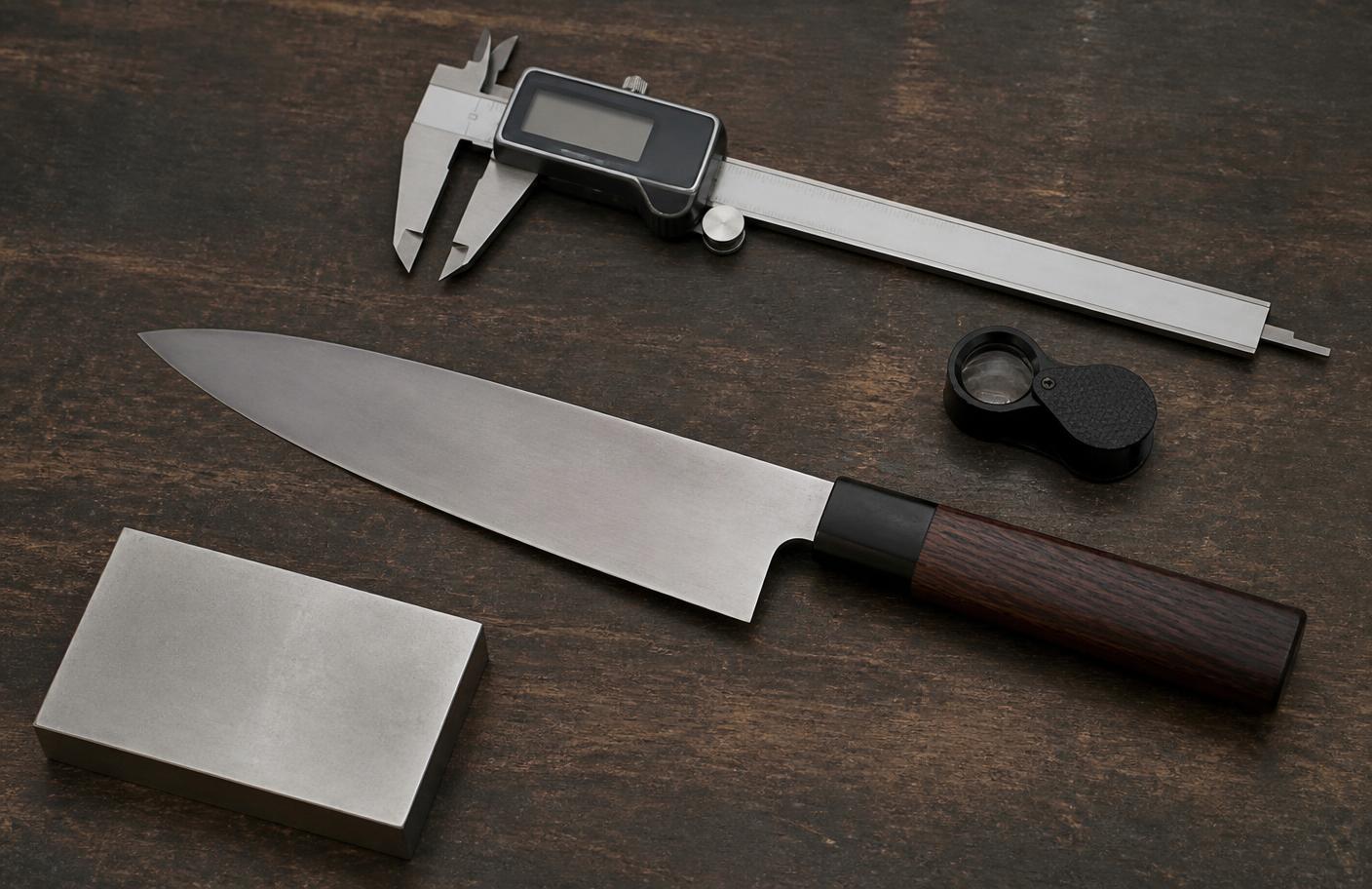
Claims that predict performance
- Named steel — VG-10, AUS-10, Aogami #2, Magnacut, 14C28N. A name lets you look up the alloy.
- Hardness in HRC — 59–63 for Japanese kitchen, 58–61 for hard-use fixed blades.
- Grind geometry — stated thickness behind the edge, or at minimum stock thickness and taper.
- Edge angle — 15° per side for kitchen work, 20° for chopping and prying loads.
- Full tang or stated tang construction on fixed blades.
- Origin and who ground it — a country plus a shop or smith, not just 'imported'.
Claims that mean almost nothing
| Claim | Reality |
|---|---|
| '67-layer Damascus' | Cosmetic. Layer count says nothing about edge retention. |
| 'High-carbon stainless steel' | Describes nearly every kitchen knife made. Not a spec. |
| 'Surgical steel' | Marketing term with no metallurgical definition. |
| 'Cuts through a nail / frozen food' | Any hard edge can do it once. It also damages the edge. |
| 'Never needs sharpening' | Physically false. All edges wear. |
| 'Military grade' / 'tactical' | Aesthetic category, not a performance standard. |
| 'Hand-forged' with no maker named | Often machine-ground stock with a hammered finish applied. |
| 'Ice-tempered' / 'cryo' with no numbers | Real process, meaningless without the heat-treat spec. |
The five-question test
What is the core steel? What is the hardness? Who ground it and where? What is the edge angle from the factory? Will you resharpen it for me? Any legitimate seller answers all five without hedging.
How to read a photo
- Does the pattern carry over the spine and into the tang, or stop at the polished face? Etched fakes stop.
- Is the same photo used across many listings and sellers? That is a drop-shipped catalogue blade.
- Are there real macro shots of the edge and choil, or only lit hero renders?
- Is a maker's mark or shop stamp visible and consistent between photos?
- Is the grind symmetrical when viewed from the tip down the spine?
Price anchoring, decoded
A slashed '$499, now $89' price on a Damascus kitchen knife is a fiction — hand-forged pattern-welded work does not clear at $89. Judge value against documented shop prices for comparable steel and finish, not against an invented list price. Where we quote value on a bundle, every line is our own everyday shop price for that exact item, and the maker's card in the box states the steel and hardness so the claim can be checked after it arrives.
Straight answers
- What is the most important knife spec?
- Steel plus heat treat, together. A modest alloy heat treated properly beats a premium alloy heat treated badly every time — which is why an HRC figure matters as much as the alloy name.
- Does layer count matter in Damascus?
- Only for the look of the pattern. Cutting performance comes from the core steel, the heat treat and the grind.
- Is 'high-carbon stainless steel' a real spec?
- No. It is a category that covers almost all modern kitchen knives. Ask for the alloy designation instead.
- How do I know a seller is legitimate?
- They name the steel and hardness, show macro photos of the actual knife, state where it was made and by whom, and will resharpen what they sold you.
Next step
Hold us to the five questions
Every listing on our rack names the steel, the hardness, the origin and the factory edge angle — and the maker's card ships in the box so you can verify it in hand.