Gyuto vs santoku: which Japanese knife should you actually buy
6 min read · Updated 2026-09-02
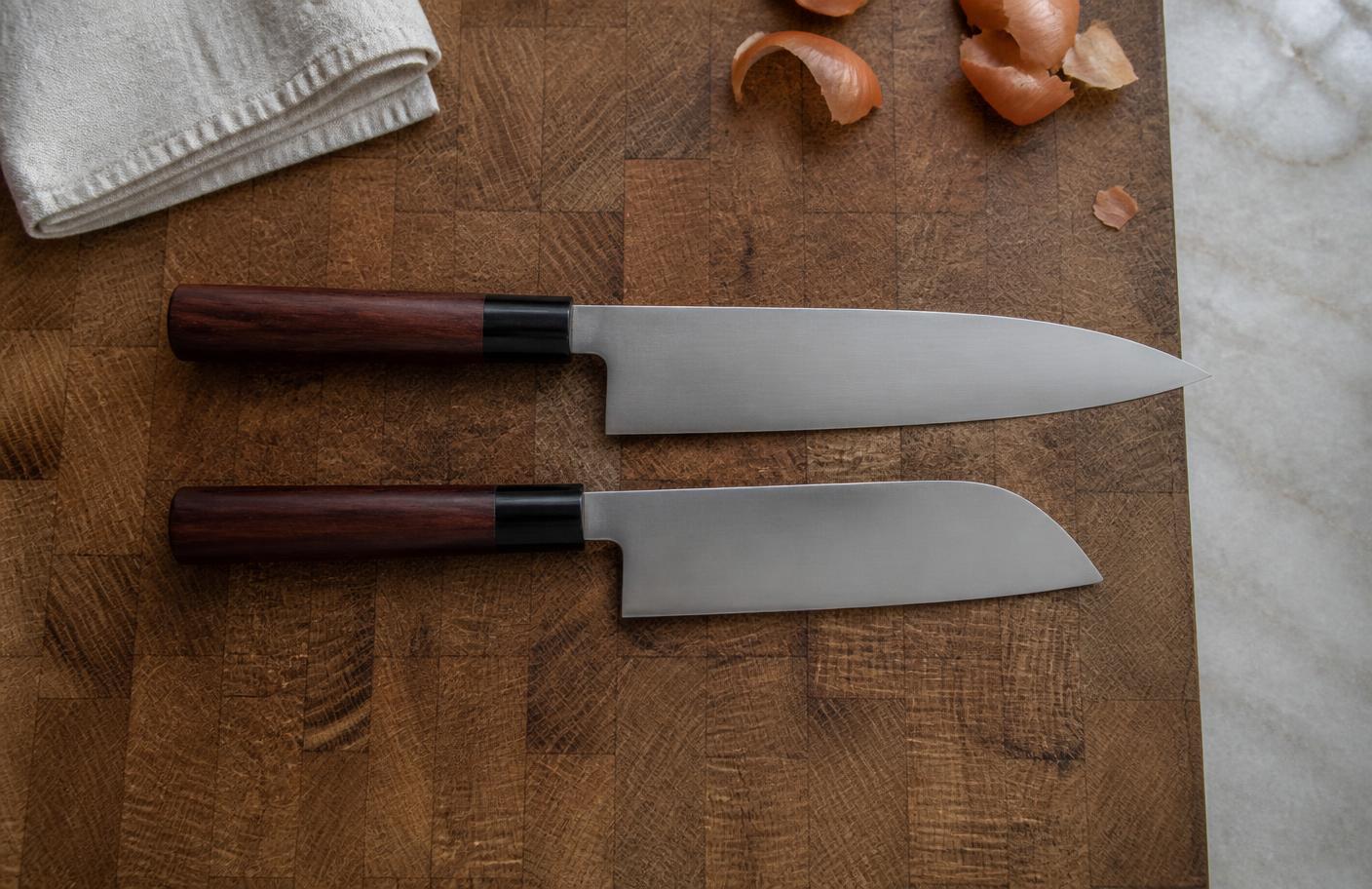
Both are all-purpose Japanese kitchen knives, and both will do 90% of your prep. The difference is geometry: a gyuto is a long, curved French-derived chef knife, and a santoku is a shorter, flatter knife built for straight-down cutting on a small board.
The short answer
- Big board, lots of protein, you like rocking the tip through herbs — gyuto, 210mm or 240mm.
- Small board, mostly vegetables, you chop straight down and want control — santoku, 165mm or 180mm.
- One knife for a small kitchen and mixed cooking — 180mm santoku or a 180mm gyuto splits the difference.
- Already own a Western 8-inch chef knife — buy the santoku; it does something your chef knife does badly.
Spec-for-spec comparison
| Gyuto | Santoku | |
|---|---|---|
| Typical length | 210–240mm (8–9.5in) | 165–180mm (6.5–7in) |
| Profile | Continuous belly, pointed tip | Flat edge, sheepsfoot tip |
| Best motion | Rock and glide slicing | Push cutting, straight chop |
| Protein work | Excellent — length carries through a roast | Limited — too short for large cuts |
| Vegetable prep | Very good | Excellent — full edge contacts the board |
| Board space needed | 45cm+ comfortable | Works on a 30cm board |
| Tip work | Fine detail, boning-adjacent tasks | Blunt tip, less precise |
| Learning curve | Needs board discipline | Very intuitive |
Why the flat edge matters more than the length
The single biggest complaint we hear from new Japanese-knife buyers is accordion cuts — slices still joined at the bottom. That is almost always a rocking motion used on a flat-profile knife, or a curved-profile knife on a board too small to complete the arc. A santoku forgives nothing about motion but rewards a straight chop; a gyuto forgives motion but demands board space. Match the knife to what your hands already do, not to what a video told you to do.
Handle style is not a small detail
A Japanese wa handle is lighter and shifts balance forward; a Western yo handle is heavier and balances at the bolster. If you have larger hands or you grip hard, hold both before deciding — this changes comfort more than 15mm of length ever will.
Steel choice for each
| Steel | Fits | Trade-off |
|---|---|---|
| VG-10 (stainless clad) | First gyuto or santoku | Keen, stain resistant, easy upkeep |
| AUS-10 Damascus | Working home kitchen | Tough, quick to sharpen, forgiving |
| Aogami / blue carbon | Cooks who dry the blade every time | Sharpest feel, will patina and can rust |
| Shirogami / white carbon | Sharpening enthusiasts | Superb edge, least forgiving of neglect |
What we would buy at each budget
- Under $150 — 165mm stainless-clad santoku. Best value in the entire Japanese lineup.
- $150–$275 — 210mm VG-10 or AUS-10 Damascus gyuto. This is the sweet spot for most home cooks.
- $275–$450 — hand-forged carbon gyuto with a documented hardness, or a maker-signed santoku.
- $450+ — buy the maker, not the category. At this level you are paying for a specific smith's grind and finish.
Straight answers
- Can a santoku replace a chef knife?
- For vegetable-heavy home cooking, yes. For breaking down large proteins, carving roasts or slicing a watermelon, a 210mm gyuto or chef knife is the better tool.
- Is a gyuto the same as a chef knife?
- It is the Japanese interpretation of one: thinner stock, harder steel, a flatter belly and a more acute edge angle, usually 15 degrees per side instead of 20.
- What size gyuto should I start with?
- 210mm. It fits standard home boards and handles both protein and vegetables. Move to 240mm only if you cook on a commercial-size board.
- Are Damascus gyutos better than plain-finish ones?
- No — the cladding pattern is cosmetic. The core steel and heat treat decide performance, which is why we list both on every knife.
Next step
See which one is on the rack
Every Japanese knife we list shows length, core steel, hardness and handle style, so you can check it against the table above before you commit. Drops are limited and single-unit, so sizes move fast.