Your first Japanese chef knife, by budget
7 min read · Updated 2026-09-02
Price in Japanese knives buys three things, roughly in this order: heat-treat consistency, grind thinness behind the edge, and finish work. Almost nothing above $300 makes food easier to cut — it makes the knife nicer to own and easier to maintain sharp.
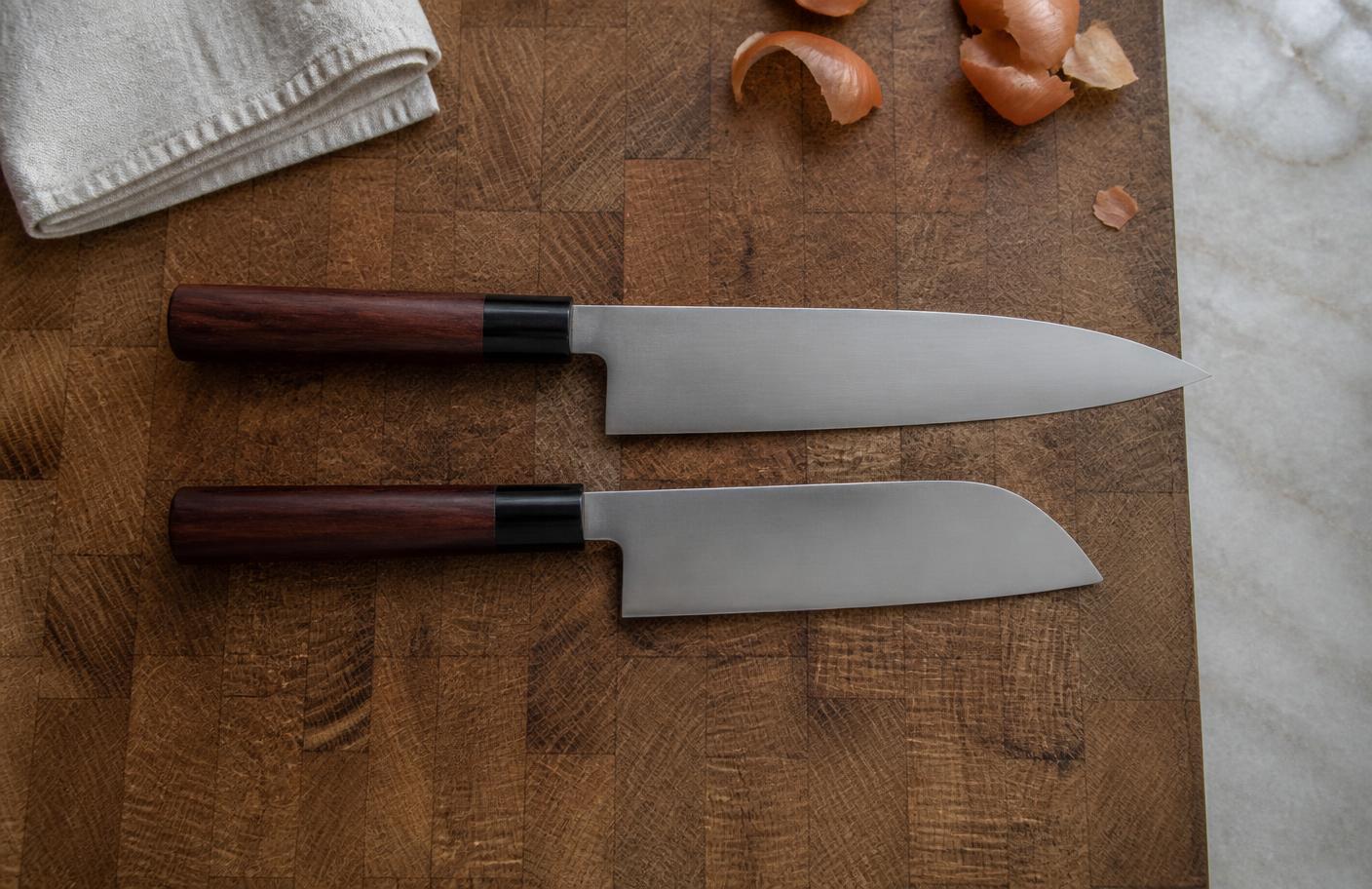
What each price bracket really buys
| Budget | What you get | What you give up |
|---|---|---|
| $90–$150 | Stainless-clad VG-10 or AUS-10, machine-ground, 165–180mm | Thicker behind the edge, plainer fit and finish |
| $150–$275 | Consistent heat treat, thinner grind, 210mm gyuto options, real handle materials | Not a named maker; finish is good not exquisite |
| $275–$450 | Hand-forged, documented hardness, hand-finished edge and handle | Carbon options need drying discipline |
| $450–$800 | Named smith, distal taper, refined kasumi or migaki finish | Diminishing cutting returns; collector territory |
| $800+ | One-of-one work, rare cladding, signed and boxed | Bought as an object, not a tool |
Spend the last $60 on stones, not steel
A $150 knife on a $60 stone setup outperforms a $400 knife that never gets sharpened. If your total budget is fixed, buy the cheaper blade and the 1000/3000 grit combination stone.
The honest starter kit
- One knife — 165mm santoku or 210mm gyuto. Not a block set. Sets pad margin with knives you will never touch.
- A 1000/3000 combination whetstone and a flattening plate.
- An end-grain or soft-plastic board. Glass, granite and bamboo destroy hard Japanese edges.
- A saya, edge guard or magnetic strip. Drawer storage chips tips more than cutting ever does.
- Camellia or mineral oil if you choose carbon steel.
How to read a listing before you buy
- 01Find the core steel by name. 'Damascus' or 'high-carbon steel' with no alloy named is a red flag.
- 02Find the hardness in HRC. Kitchen Japanese blades should sit around 59–63 HRC.
- 03Check stainless-clad vs full carbon, then be honest about whether you dry knives immediately.
- 04Check the length in millimetres against your board, not against a photo.
- 05Check the return and sharpening terms. A seller who will not resharpen their own grind is telling you something.
Mistakes that cost first-time buyers money
- Buying 240mm because it looks serious, then never using it on a 30cm board.
- Buying full carbon before building the habit of drying the blade.
- Buying a set to 'save', then owning six knives and one favourite.
- Buying a single-bevel yanagiba as a first knife. It is a specialist slicer, not an all-rounder.
- Using a pull-through sharpener on a 62 HRC edge. It tears the apex out.
Straight answers
- How much should I spend on my first Japanese knife?
- $150–$275 is the value peak: consistent heat treat, a thin grind and a proper handle, without paying for collector finish work.
- Is a $100 Japanese knife any good?
- A stainless-clad VG-10 or AUS-10 santoku near $100–$150 is genuinely good. Below about $80, expect soft steel, thick grinds or an etched pattern rather than real pattern welding.
- Should my first Japanese knife be carbon or stainless?
- Stainless-clad, unless you already wash and dry knives by hand immediately every time. Carbon rewards discipline and punishes everything else.
- Do I need a whetstone?
- Yes. Hard Japanese steels cannot be maintained properly with a pull-through sharpener, and a 1000/3000 stone plus a few minutes a month keeps a knife at its factory edge for years.
Next step
Match a budget to a blade in stock
Our listings state steel, hardness, length and origin up front, so you can shop the bracket you just picked instead of guessing from photos.