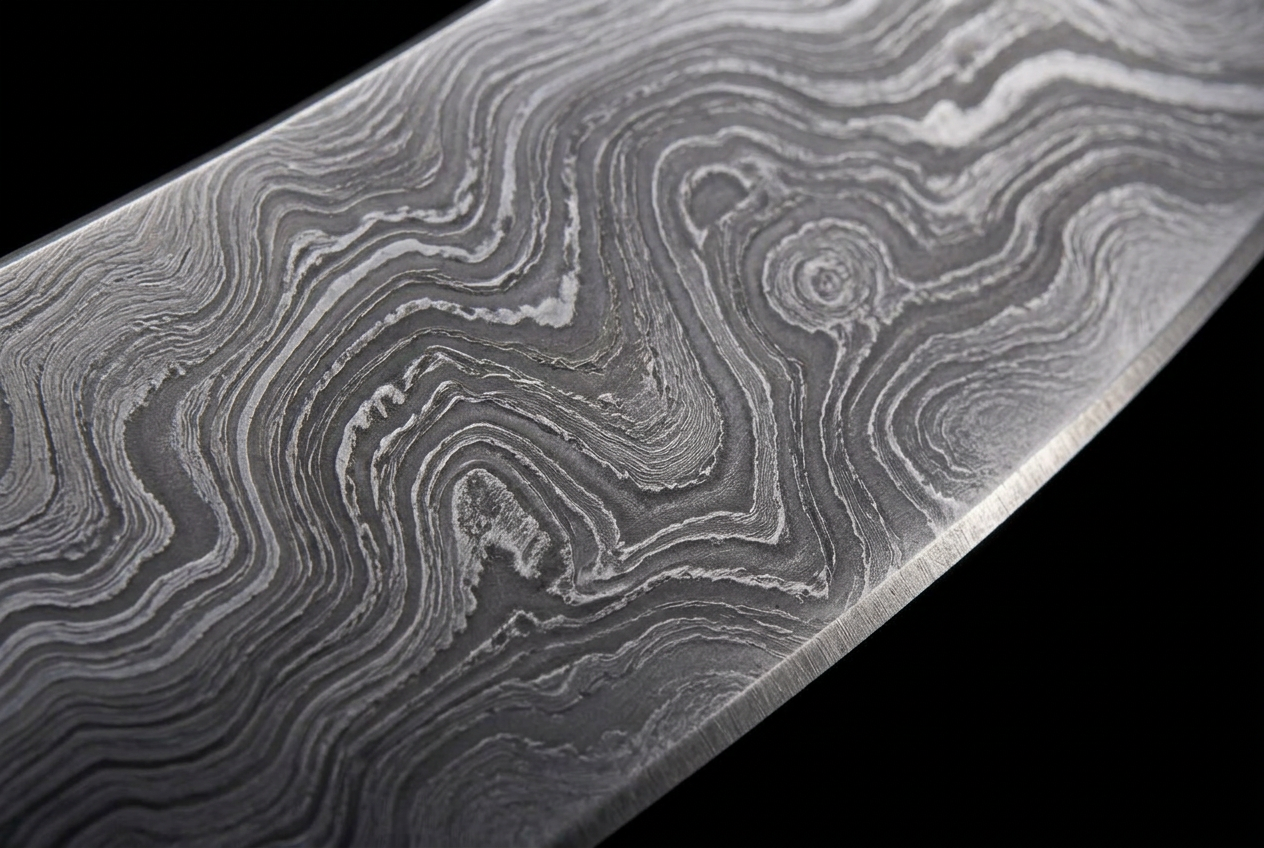
Pattern-welded steel
Damascus blades
Pattern-welded billets, hand-etched so the layers read as depth rather than print. Every listing states the core steel, the layer count the smith gave us and the finish — because a pattern alone tells you nothing about how a knife cuts.
- Construction
- Forge-welded billet, etched
- Typical core
- VG-10, AUS-10, carbon
- Edge care
- Whetstone, oil after use
- Listed on every blade
- Steel, layers, origin
The rack
Damascus on the rack
Opens at launch
Damascus listings go live with the first run
We are finishing this run with our smiths. Get on the drop list and you will see the damascus pieces — steel, origin, price — before the rack opens publicly.
Our standard
What a damascus piece has to pass
The pattern goes through the steel
We etch a test area on samples. Surface-printed 'Damascus' gets rejected before it reaches a listing.
The core does the cutting
San-mai and cladded blades are listed by their core steel, not by the cladding that looks pretty.
Grind before decoration
If the bevel is uneven or the edge is thick behind the apex, the pattern does not save it.
What this is not
Damascus is not a hardness rating and not stainless by default. If you want a knife you can leave wet in a sink, buy a stainless-core piece and read the care guide first.
Read first
Buy this category properly
Straight answers
Damascus questions
Is Damascus steel actually better?
Not inherently. The core steel, heat treatment and geometry decide performance. Damascus decides how it looks and how the smith built it.
Will the pattern wear off?
Not on a genuine forge-welded blade — the layers run through the steel. It will fade on an acid-printed fake, which is one way to spot one.
Keep looking